Thursday, October 6, 2016

Native American Customs: A Thematic Unit Grades 1-3


November is right around the corner... I know crazy right? One more month and we'll be talking about turkeys, pilgrims and Native Americans! Speaking of Native Americans, I've created a thematic unit jammed packed with fun and engaging activities in reading, writing, math, science, poetry and social studies. If you LOVE teaching units cross curricular, then keep reading and enjoy the pics! 


In this packet are 18 days of lesson plans with mentor texts.  Each lesson plan has a step by step sequence of questions, activities, extensions, materials and examples with photos and templates. 


There are vocabulary cards for each Native American tribe: Plains, Northwest, Northeast, Southwest and Southeast regions. Each set of cards include the children, shelter, food and other items. There are also cards for the scientific method, corn life cycle and parts of corn. 


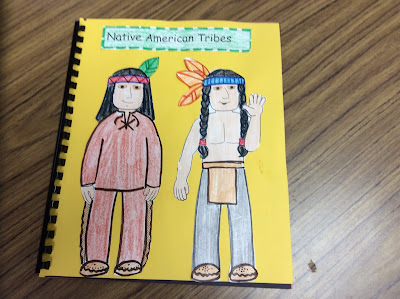
There are craftivities that I've created to accompany The Legend of the Bluebonnet and The Legend of the Indian Paintbrush. Theres also a Squanto Mobile, Thanksgiving Placemat, Corn in the Cornfield, and a Native American Tribe student book. 


After learning about Squanto and the first Thanksgiving,
the students make a mobile to hang in the classroom.


The students create a flip book of past and present homes: a tepee and a modern day house. Under the flaps they write a list of characteristics for each home and then in the middle they write a list of what's the same about both. It's actually like a Venn Diagram but in a flip book style. 


After reading the Legend of the Bluebonnet, we discuss beginning, middle and end and the students complete their template to glue on their craftivity. 


After reading The Legend of the Indian Paintbrush, the students complete their template about text connections, and glue it onto their craftivity. 


For the Native American book, the students will learn about each tribe and color pictures to glue into their book. Then complete a 4 square about the landforms, shelter, food and region. 


I've also created interactive notebook activities for poetry, math, science and social studies.


The best part about this packet???? Is the Thanksgiving Feast! Each year our students dress up like either a Native American or Pilgrim, they make a placemat to eat their trail mix and we gather in the cafeteria and recite Thanksgiving poems and sing songs. The parents come and join us and it's such a great gathering of friends and family!  Here is the placemat that I have my students make. I give them a cornicopia to color and cut out, they decorate the border with fall colored squares and then the fill out their template about what they are thankful for! Then they get to take it home and use it for their own Thanksgiving dinner! 


I hope you got some really good ideas about how to incorporate your Native American unit with cross curricular activities. If you are interested in checking out my unit, click below: 

Native American Culture: A Thematic Unit Grades 1-3

Love, Kara 


Monday, September 26, 2016

Linking Literature: Owl Moon Grades 1-3


Don't you just LOVE Owl Moon by Jane Yolen? This is one of my favorite books to read to my class. There are so many skills that you can teach from this book and I can't wait to share them with you! I typically read this book in October when we are studying about owls and bats, and it goes perfectly with our genre study of realistic fiction.

Comparing Fiction/Realistic Fiction 
The students compare two different owl stories: one fiction and one realistic fiction. They write down similarities and differences on their Venn Diagram. Then, as a craftivity, students color and cut out an owl and then label the parts of it. This is one of my favorite craftivities.  My students compared Owl Moon with Owly. 

Owl Moon Craftivity
Another fun activity to try in reading is cause and effect and author's purpose. I've created anchor charts for each of these:

Anchor Charts
Both of these activities could be used for a reading interactive notebook activity:
Owl Moon Author's Purpose
Owl Moon Cause and Effect

Another great extension to this book is to teach the owl life cycle. I've created a craftivity to help the students understand how the life cycle works. The students color and cut out their pictures, and then write an expository piece about the owls.
Owl Life Cycle

I've also created vocabulary cards to show the students the different stages of the life cycle.
Life Cycle Vocabulary Cards

You can also integrate science into this book using energy. Ask your students how do owls use energy? How do they use heat? How do they use light? How do they use sound? You'd be amazed at the answers that the students will think of! They can illustrate their energy and write a sentence about each one. 
Science Interactive Notebook

Another way of integrating science is by teaching force and motion: how do owls move? How do they move zig-zag? How do they move up and down? How do they move side to side? What do they push and pull? How do they go fast and slow? By using this fold-able, students can draw or write sentences under the flaps about how the owl moves using this motion. 
Science Interactive Notebook

I hope you got some great ideas about how to incorporate reading, writing and science with Owl Moon! If you are interested in checking out my packet, click below:

Linking Literature: Owl Moon Grades 1-3

Love, Kara


Saturday, September 17, 2016

Rockin' Inside the Earth: A Rocks and Soil Thematic Unit Grades 1-3


One of my favorite thematic units is teaching about rocks and volcanoes. My students learn so much from this unit and it is jammed packed full of engaging, hands on activities that will spark their interest. I usually teach this thematic unit in the spring, but there are bits and pieces of it that I teach through out the year. I can't wait to share with you some of the great activities that I've created for this unit! It includes lesson plans with mentor texts, craftivities, interactive notebooks, poetry, vocabulary cards and science experiments. So, let's go rock hunting!

I've created 17 days of lesson plans with mentor texts, materials, directions, and examples.  They are very user friendly and easy to follow.


I've created many craftivities that include building the layers of the earth with play-do, an edible dirt cup, painting a pet rock, the parts of a volcano, a rock cycle spinner, sorting the three types of rocks and living on landforms. Each craftivity also has a writing template to extend the lesson if you wish. 


The edible dirt cup is so easy! Just layer your cup starting with chocolate pudding, crushed Oreos, green coconut and on the top put gummy worms! The students will LOVE this! This is such a fun and easy way to teach the layers of the soil. 

Creating the layers of the earth is also fun! All you need is red, yellow, green and blue play-do. Show your students how to roll a small red ball of play-do and then layer the other colors on top starting with yellow, then green, then blue. With a couple inches of floss, slice the ball in half and open up the ball to show the layers inside. This is so cool and amazing. What a great way to learn about the core, mantle and crust! 

Oh how I love Pet Rocks! How fun and super easy too. Ask your students to bring in a small rock that they have found at home. Put out some tempera paint with different sized brushes and paper plates for each table group. After the paint dries, students can glue on their googly eyes. These pet rocks can sit on the students' desk during your unit and then take them home! The students can also complete an interactive notebook page about their pet rock's properties. 


I've also created lesson plans for science experiments. My favorite one is the erupting volcano. This is so easy to do. All you need is vinegar and baking soda. I like to use the yellow solo cups and cut out a hole at the bottom of them. I put a baby food jar inside the solo cup with a teaspoon of baking soda. Make sure to put them inside a plastic bowl, so when the eruption happens, it will not go everywhere! Students will pour about 2 tablespoons of vinegar really fast and see how the baking soda erupts like a volcano. This is so fun and the students LOVE it! 
Another science investigation is observing different types of rocks. I have these AWESOME rock kits that we ordered many years ago and they have the different rocks labeled and a short blurb about each one. I have a class set of these so each student can be a rock hound! I've also created a template for the students to record their information and illustrate their rocks. 

I've also created some interactive notebook activities for poetry, math and science. 


I've created anchor charts for the layers of the soil and of the types of landforms. 


I also use vocabulary cards to help my students learn new academic vocabulary. I display these on my chart stand, pocket chart and even in my theme center! 


And, speaking of my theme center... this is where I display posters of rocks and volcanoes and put all different kinds of rocks on display for my students to observe and write about. I also put out rock games, activities and books to read. 


I hope you have gotten some great ideas about how to teach your rocks and soil unit. If you're interested in checking out my packet, click below. 


Love, Kara 


Sunday, August 28, 2016

Linking Literature with Stellaluna: Grades 1-3


If you have the book Stellaluna by Janelle Cannon and you haven't found the right activities to use with it... well you're in luck! I've created a packet that has a lesson plan, craftivities, interactive notebooks, vocabulary cards, and writing templates that go along with this book. They are fun, engaging and allow your students to LOVE literature! 
During the month of October, when we were using owls and bats to teach with our genres, Stellaluna was a perfect fit for teaching the students what Fiction was.  We talked about how Fiction is a fake story and that the characters typically are drawn like cartoon characters. The characters also can talk, wear clothes or do things that a real person could do. And, fiction stories have a problem, solution, cause and effect.  So, I created a lap book that goes along with these Fiction traits. On the cover we glued Stellaluna on top of a moon and then labeled the parts of a bat. The students LOVED doing this craftivity! They used toothpicks as her fingers and googly eyes. I had the students pick a colored file folder that they wanted to use. I just LOVE these! 

Cover of Lap Book 
Inside the lap book we glued the sequence of events and characterization 4 square.  They illustrated Stellaluna and colored the background. 

Inside the lap book

Other activities that you could have your students do are Author's Purpose and Synthesis.
Author's Purpose and Synethsis

I also created some vocabulary cards with parts of a bat and the life cycle. You could use both of these to display on an anchor or pocket chart next to the story.
Parts of a Bat
The Bat Life Cycle

Another craftivity that you could have your students do is labeling the parts of a bat and then writing an acrostic poem about Stellaluna.
Acrostic Poem and Craftivity

I've also created some writing templates both in color and black and white! One prompt could be to write an expository piece about bats called "I"m Going Batty!" and the other could be a narrative about "If I Were Stellaluna..." Both of these you could staple into the lapbook, or glue onto the craftivity.
Expository and Narrative Writing

Some interactive notebook activities I've created are:
The Bat Life Cycle and Bats Can, Have and Are...
Also in color and black and white.
Interactive Notebooks

I hope you got some really good ideas on how to implement Stellaluna into your curriculum this fall! It's such a fun story and it really has a lot of great teachable moments! If you are interested in checking out my Linking Literature Packet, click below:

Linking Literature with Stellaluna: Grades 1-3

Love, Kara

 Graphics Courtesy of: