Tuesday, July 19, 2016

1492: A Maps and Columbus Thematic Unit Grades 1-3


Sailboat Jell-O
(The best part about this thematic unit.... is the Jell-O!!!!! All you need is blue Jell-O, a plastic clear cup, coffee filters, toothpicks and mandarin oranges... yummy! )
Are you thinking about what units you'll be teaching in the fall? If you've ever taught maps and Columbus, you probably know that you can incorporate a TON of skills into this unit. I really had fun writing this one. This unit includes: Lesson Plans with Mentor Texts, Vocabulary Cards, Craftivities, Interactive Notebook Activities, Problem Solving, Science Experiments, Poetry, Expository Writing and Riddles. I'm so excited to share this unit with you! Under the umbrella of maps and Columbus, I also included: Landforms, Magnets, Force and Motion, Cardinal Directions, Parts of a Ship, Riddles, Expository Writing and Capacity.


Maps and Columbus Cover Page
I've written 16 days of lesson plans with mentor texts, materials, directions and examples.
Lesson Plans with Mentor Texts

I've also included vocabulary cards and anchor charts. The vocabulary cards include:

The Continents
The 3 Ships
Columbus Characters
Landforms

This is an excellent way to give your students visuals... and they are colorful and cute!

Vocabulary Cards
Anchor Chart: Living on Landforms
You know I LOVE to incorporate my craftivities, and I included a lot of room for creativity here. 

I Spy a Spy Glass
: the students will use a paper towel roll and a plastic cup and cut out the bottom of the cup to stick on the end of the paper towel roll. Then, decorate it with paper and jewels.
I Spy a Spy Glass
Did You Ever See a Magnet: the students will color their magnet and picture templates and sort them according to if they attract to the magnet or not.
Did You Ever See a Magnet? 
Living on Landforms: the students can cut out the landforms free hand using colored construction paper and layer them. After glueing them on a background, then they can glitter and glue on the labels.
Living on Landforms 
Columbus Sailed the Ocean Blue: the students color and cut out the three ships and Columbus and glue them onto their construction paper and then write an autobiography about Columbus.
Columbus Sailed the Ocean Blue

A thematic unit isn't complete with out experiments! I've included experiments for magnets, force and motion, and capacity. I bet your wondering... why is there an experiment about magnets in this unit? Well, I incorporate the compass into this unit and discuss how it always points north because the poles of the earth are magnetic too! This is a perfect segue into learning about magnetic force! With these experiments, I've included a lesson plan with materials and directions and a student interactive notebook page for their science notebook.
Experiments

Another part of this unit that is a great addition are more interactive notebook activities! I've included poetry, math and social studies. For math, the students can complete a problem solving activity using ships. For poetry, the students can cut out their poem and glue it into their poetry notebook and illustrate a picture with a caption. For social studies, I've included a compass rose to label, and to drawing a map of the students' room.


Interactive Notebooks

Last I'd like to share the writing portion of this unit. I think that writing is so important and can be incorporated into everything! I've written templates for two expository pieces: Columbus Sailed the Ocean Blue and Parts of a Ship. 

Writing Templates: Brainstorming and Final Draft
I hope you got some great ideas on how to incorporate maps and Columbus in your classroom for the fall! If you are interested in my thematic unit, click below.

1492: A Maps and Columbus Thematic Unit Grades 1-3

Love, Kara


Graphics Courtesy Of: 

Sunday, July 17, 2016

It's Raining Cats and Dogs! A Weather Thematic Unit Grades 1-3 


Have you started to think about what you'll be teaching in the fall for science? If you love teaching thematic units cross curricular, check out this weather unit!  I LOVE teaching my students about weather and meteorologists. There are so many awesome skills that the students can learn. This unit includes 20 days of lesson plans with mentor texts, vocabulary cards for different types of weather, (weather tools and clouds), anchor charts, scientist/meteorologist expository writing, a weather investigation journal, weather experiments, weather poetry, craftivities and a class book about clouds. Each component is fun and engaging for the students! I hope you enjoy it!


Weather Packet Cover Page

I've written 20 days of lesson plans for this unit and they all include mentor texts, materials, directions and examples.


Weather Lesson Plan Examples

I use vocabulary cards and anchor charts with every unit. These are excellent visuals for the students to understand the skills and concepts that you are teaching them. You can also display them around the classroom for a resource later on. Here are my examples of anchor charts and vocabulary cards:

Weather Anchor Charts

Just in case your wondering, I use the cause and effect anchor chart with the book Thunder Cake, and the sequence of events anchor chart with the book Cloudy with a Chance of Meatballs.
Here are my vocabulary cards: 

Weather Tools Vocabulary Cards
and
Types of Weather and Clouds


Also included in this unit are craftivities. Ya'll remember how I LOVE to include craftivities within my units? They are engaging, fun and allow for imagination and creativity. Here are some examples of some of my craftivities from this unit. Most of these I like to hang in the classroom or out in the hallway. 

Craftivities for Weather Unit

The students can make a pinwheel when they learn about what makes the wind, two different kinds of rainbow craftivities when learning how a rainbow is made, and reading and writing about meteorologists and what their job is.


You can't have a unit without interactive notebooks! Here are some examples of some interactive notebook activities for science. All you need to do is copy and shrink these down so they'll fit inside the notebooks. Usually these follow a science experiment, poetry, or reading activity.


Interactive Notebook Activities

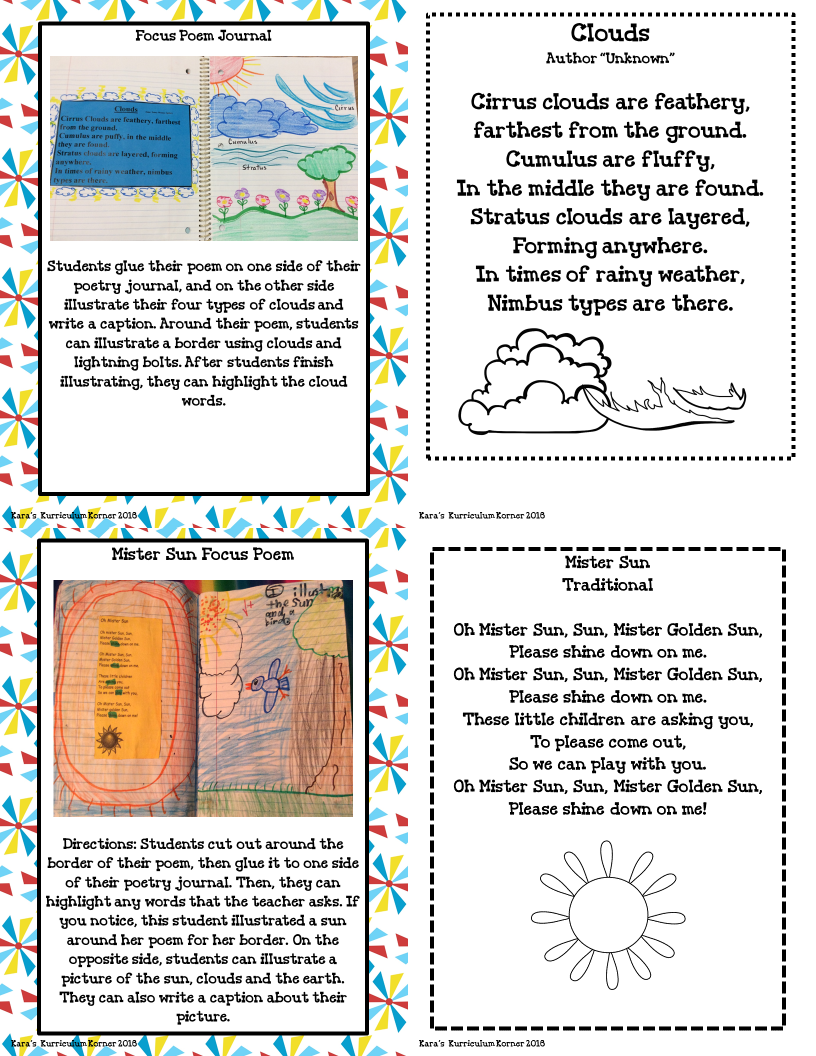
For Poetry Notebooks, the students have two poems they can illustrate, cut out and glue into their notebook. I usually have the students highlight either nouns, verbs, or adjectives in the poem, depending on what skill we are studying for that week. I also have them write a caption at the bottom of their picture describing what they illustrated.  Here are my poetry notebooks: 


Focus Poetry Notebooks

For the science experiments, there is a rainbow experiment using a prism and an overhead projector. A cloud in a cup using a plastic cup, water, shaving cream and blue food coloring. And a tornado in a jar using a marble, water, dish soap and red food coloring. All of these are also interactive notebook activities after the students conduct the experiment.  I typed out the lesson plan with materials, directions and a photo of the experiment for better understanding. Here are the examples:

Cloud in a Cup
Tornado in a Jar 


Cloud in a Cup and Tornado in a Jar Experiments 

When investigating weather, the students can also use a weather  journal. You could have the students look out the window daily, or take a walking field trip outside your school to observe the weather. I like to hang a rain gauge and a thermometer outside my window so the students can look at it easiest from inside the classroom. The weather journal is for 10 days and includes a cover page, daily weather recording, weather graph, problem solving and recording the students' favorite weather at the end of the packet. Here are some of the pages of the student journal:

Student Weather Journal
Click Here for my Weather Journal:

My Weather Journal Grades K-2

If you are interested in checking out my Weather Thematic Unit for Grades 1-3, click below. I hope you got inspired to try some weather in your classroom for the fall or spring. No matter what time of year you decide to teach this unit, your students will LOVE it!

It's Raining Cats and Dogs! A Weather Thematic Unit Grades 1-3

Love, Kara
Graphics Courtesy of:


Tuesday, July 5, 2016

Guided Reading and How I Use It

Guided Reading is an essential component of Balanced Literacy. This allows you to get up close and personal with your young readers. I always enjoy my time with my students during guided reading, it really helps me tune in to their needs, struggles and successes. And, they LOVE to read to me at my table! 
In my first grade classroom, I have 5 reading groups. My reading groups are color names: Turquoise, Magenta, Tangarine, Violet and Jade. This way the students don't really recognize who is the low and who is the high reading group. They're all colorful! 
Here is a picture of my guided reading baskets: 


5 Baskets for 5 Different Reading Groups 
I got these baskets at Wal-Mart and I made the name labels to match their color. I meet with 2 groups on Monday, Wednesday and Friday, and 3 groups on Tuesday and Thursday. This includes my literature circle who meets on their own. I spend about 15 minutes with each group. This is during my Reader's Workshop time while the rest of the class is working quietly on schema notebook so I have a quiet environment. I also have music playing quietly in the background with my bird contest going on. 
I have two different lesson plans that I use for guided reading. Here is the one I use for 3 days a week:


Lesson Plan for 3 Days a Week 

Here is the lesson plan that I use for 2 days a week: 


Lesson Plan for 2 Days a Week
During my guided reading groups, I teach my students "Fix-Up" Strategies to use when they come to a word they don't know. I use this teacher poster below. I have it laminated and handy in my teacher binder. I show the students this list of strategies and we do hand motions for each one. The students HAVE to tell me which strategy they are going to try before we start reading. Their challenge is to try that strategy that they told me when they get to a word they do not know. Here is the teacher template: 


Fix Up Strategies: Teacher Copy
I also made posters to laminate and put up on a bulletin board or word wall. They have real photos of my daughter doing these strategies. 


I also made bookmarks for the students to use during guided reading, independent reading, buddy reading, literature circles, or literacy centers. They can keep this inside their book at all times. You could also have them cut it out and glue it inside their reader's notebook for a resource!
All you need to do is print and laminate!


Student Bookmarks

At the end of the guided reading lesson, my students do word work, schema notebook or comprehension questions. Depending on the level and needs of the group, I decide what they need to do. I have popcycle sticks that I wrote questions on. I have them inside a cup and the students draw a stick and read it out loud. Here are some of my questions:

Who are the characters?
Where was the setting?
Was there a problem?
How was the problem solved?
What was the author's purpose?
Tell the beginning, middle and end.
What was your favorite part and why?
What was the genre? 
I hope you have gotten some great ideas to use for guided reading! If you are interested in checking out my Guided Reading Packet, click below: 

Are You Fixed Up for Guided Reading? Grades K-3

Love, Kara 

                                     Graphics Courtesy Of: 

                                    Kimberly Geswein Fonts 


Monday, July 4, 2016

Birds of a Feather: An Owl Thematic Unit Grades 1-3

Get a jump start on units for the fall! 

Owls That Students Have Made for Home Project
In the fall, I like to teach a thematic unit on owls. During this unit the students learn about the owl life cycle, force and motion, heat, light and sound energy, realistic fiction and fiction stories, the owl food chain, and types of owls and their habitats. They are engaged in many hands-on activities that allow them to experience owls first hand. They LOVE this unit! 
At the beginning of the unit, I send home a letter to the parents telling them about our monthly home project. This home project is to research an owl and make a 3-D model and bring it back on the assigned date. As you can see in the picture above, these are some of my students' owls they have made in the past. I also display them in my theme center if they donate them to the class. Here is the template that I use for my students to research their owl: 

Owl Research Template
The students learn so much from this research and the best part is that they get to spend time with their family at home making it! 


There are many different science investigations that go along with this unit. My favorite one is learning about all different kinds of feathers. I bring in 8 different kinds of feathers from birds I have collected over the years: Turkey, Chicken, Owl, Ostrich, Falcon, Sparrow, Peacock, and Hawk. I put these feathers in a baggie and put a number on them. Here is a picture of my feathers: 

Bird Feather in Baggies... and my daughter holding some! 
I lay these feathers around the classroom in stations. The students travel around the room with their clipboard, pencil and feather template and illustrate the feathers and label them. This gives the students a chance to move around while still investigating.  Here is the template I use for "Birds of a Feather". 

Birds of a Feather Template
Another investigation that I LOVE is investigating Owl Pellets. Each year I order owl pellets and the students pick them apart to see what the owl has eaten. They build the skeleton together and then I hang them in the classroom. Here is a picture of my skeletons from owl pellets.

Skeletons from owl pellets

For our interactive notebooks, I teach a lesson on force and motion. Since owls can fly, this is goes perfectly with this skill. The students practice flapping their arms in the classroom and pretend they are owls. We practice going zig-zag, side to side, up and down, fast and slow. These are all examples of types of motion. Then, the students complete a science fold-able called: How an Owl Moves. They glue it into their science notebook:
Force and Motion Fold-able
Another interactive notebook activity we do is learning about energy. We discuss heat, light and sound and brainstorm ways that people use these types of energy first. Then, to extend our thinking, we brainstorm how the owls use energy. This really gives the students higher level thinking skills. These questions are open ended, so the students may think of not one way the owl uses this type of energy but three or four ways! Here is the template that I use:
How Do Owls Use Energy?

I also do some craftivities with my students. (You know how I LOVE using art in the classroom!) During this unit we learned about fiction and realistic fiction books. We compared two different owl books and made a craftivity. We used a Venn Diagram to compare and then make an owl with labels. Here is a picture of the craftivity:
Craftivity: Comparing Fiction and Realistic Fiction Owl Stories

Another craftivity we do is the owl life cycle. Here we learn about how the owl life cycle is similar or different than our own. I have my students write a sequence of the life cycle to put with it. Here is a picture of my life cycle craftivity: 
Craftivity: Owl Show You the Life Cycle 

My favorite part about this unit, is that the students have an owl book that they can research a different owl each day. I read them a story about a specific owl and we brainstorm facts about the it, then the students can complete their page in their owl book. We talk about where it lives, how it builds its nest, what it eats and if its endangered. Here is the lesson plan that I use for each owl. There are 21 days of lesson plans in my unit.
Lesson Plan 

For the student owl book, there is a cover page, table of contents and owl research pages for:
The Barn Owl
The Snowy Owl
The Elf Owl
The Great Gray Owl
The Northern Hawk Owl
The Barred Owl
The Burrowing Owl
The Spectacled Owl
The Short Eared Owl
The Great Horned Owl

There is also a page at the end for students to illustrate their favorite owl and tell why they like it the best.

Here are some pages of the student book:
Owl Show You About Owls!

If you are interested in checking out more of my owl thematic unit, click below.  I hope you got some great ideas on how to teach owls in your classroom! Have a "Hoot" with this one!
Cover Page of Packet

Birds of a Feather: An Owl Thematic Unit Grades 1-3

Love, Kara

Graphics Courtesy of:

Thursday, June 30, 2016

That's So Corny: A Science Investigation Packet with Indian Corn 

That's So Corny!  Cover Page

If you have been reading my previous posts, you know that I just finished sharing my Science Experiments and Investigations Packet called: Let's Fall Into Science.  Then I decided to pull out some of those experiments and investigations separately to share on Teachers Pay Teachers. 

So, last year I decided to enter a Science Fair Project at my school. We did this as a class and we investigated with Indian Corn. The students really learned a lot about the Scientific Method and about growing corn.

 This is a very easy and engaging science investigation! 
You can teach this mini-unit during your theme of Natural Resources, Life Cycles, or Thanksgiving. I like to teach this min-unit in November when we are learning about Natural Resources and Thanksgiving. It goes perfectly together! 

This packet includes:

3 days of Lesson Plans with Mentor Texts
Corn Life Cycle Vocabulary Cards
Scientific Method Vocabulary Cards
Parts of a Corn Cob Vocabulary Card
Interactive Notebook activities for math and science
Craftivity: Corn in the Cornfield and Expository Writing
Science Investigation Log: That's So Corny!

So, here's how you set this investigation up: First you need Indian Corn, and if you cannot find some, Yellow Corn will do just fine. Just make sure to shuck it first before putting it into the Tupperware.  You also need 3 Tupperware containers filled with different natural resources: sand, soil and water. Here's a picture of my corn in their three different natural resources: 

Corn in Water, Sand and Soil 

How are going to hook your students in? You can set the stage by reading your first book of Corn by: Gail Gibbons. This mentor text is perfect to give an overview of corn before you start. 
You can use this scientific method fold-able for the students to ask their question and hypothesize about the corn. The students can glue this into their science notebook and fill it in as the investigation unfolds. Here is my fold-able. 

Scientific Method Fold-able
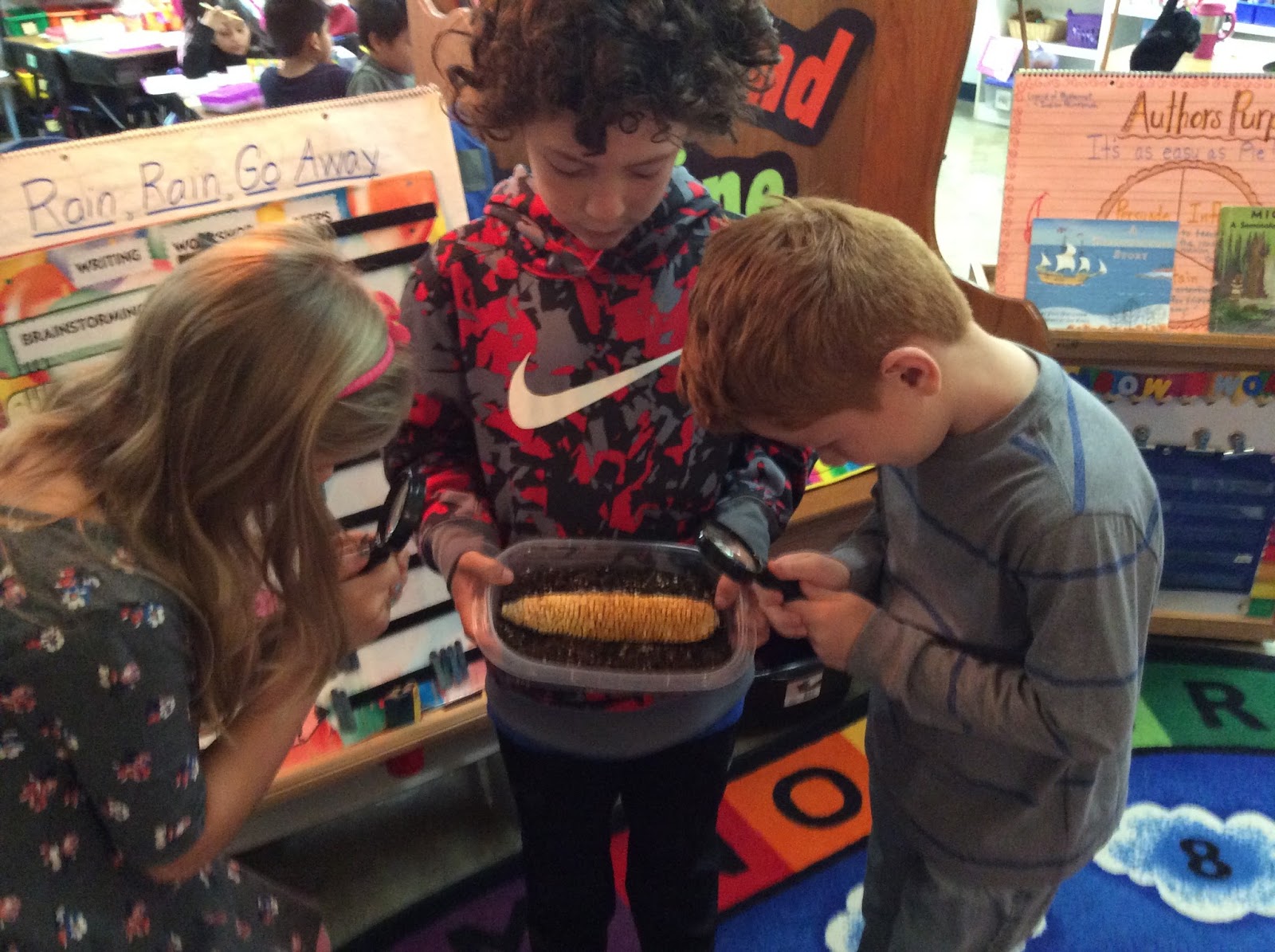
The students will start their investigation by observing the corn with a magnifying glass. You can set up the corn under a lamp, or next to your window on a shelf.  The students will hypothesize if the corn will grow better in the sand, water or soil. It's very interesting to see what they think will happen! Here is the page they can record their hypothesis: 

Hypothesis Page

Here are pictures of my students observing the corn in the different natural resources. They put their thumbs down if they didn't think it will grow, and put their thumbs up if they did think it will grow. They did this by table groups: 

Students Observing Corn

The students observed the corn for 8 days and recorded their data in their corn investigation log. This log also has a page for drawing conclusions at the end. Here is the cover page and one of the inside pages for data:
Cover Page
Data Page Day 1 

Also in the packet, the students can create a craftivity. I LOVE incorporating art with my science and social studies units. The students can write an expository piece all about corn and then make a cornfield using real popcorn!  Here is my craftivity: 

Corn in the Cornfield Craftivity 

Student Making the Craftivity

Students can also learn the parts of a corn cob using this vocabulary card:
Parts of Corn

In their science notebook, students can label the parts of corn, color, cut it out and glue it in.
Label the Parts of Corn

I hope you got some helpful ideas about growing Indian Corn in your classroom. If you are ever in a panic and need an easy, engaging science investigation for the science fair at your school, I definitely recommend this one! It is so much fun and the students LOVED it!
If you are interested in my packet, click below:

That's So Corny! An Investigation Using Indian Corn Grades 1-3

Love, Kara

Graphics Courtesy of: